
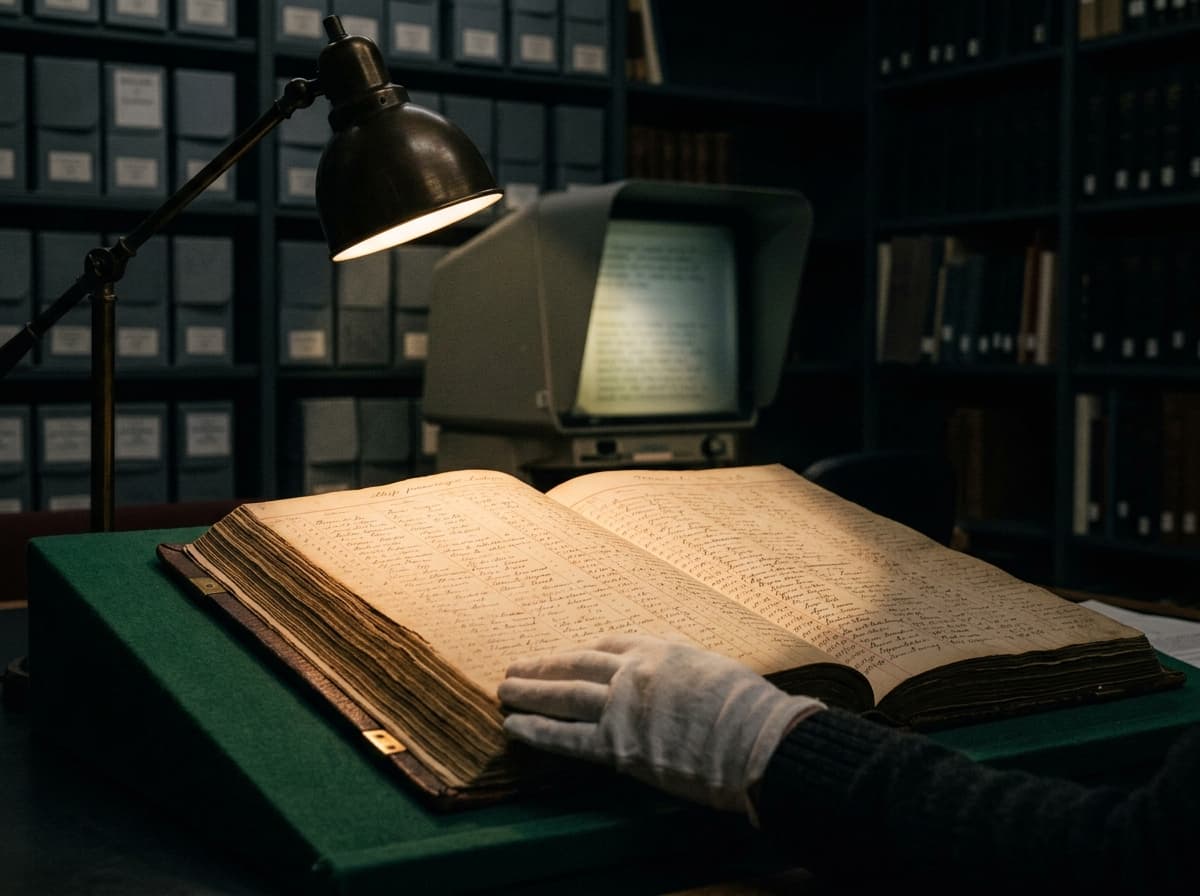
For an Article 11 claim you must show the document on the basis of which your ancestor left Croatia, usually a ship manifest or passenger arrival record. It has to be a certified copy from the archive that holds the original. A printout from Ancestry, FamilySearch or MyHeritage will not be accepted, but those sites are exactly the right tools for finding which record to order.
That distinction is the whole thing. The rule is not "genealogy websites are banned". It is "the copy must come certified from the custodial archive". Say it that way and the whole process makes sense: research on the commercial sites, order from the archive. This article is a companion to the complete document list for Croatian citizenship by descent.
What the Ministry actually asks for
The Ministry of Internal Affairs requires a certified copy of the travel or other public document on the basis of which the person emigrated from Croatia.
The Ministry of Foreign and European Affairs is more specific for the United States in its January 2025 overview: documents from the US archives, manifests, passenger lists, naturalisation documents, must be certified by the National Archives and Records Administration and translated into Croatian by an official translator.
For Canada it asks for something different again: the Canadian Landing immigrant document (IMM 1000), not an archival manifest.
The Consulate General in Los Angeles puts the American rule in its own words on its list of 20 June 2025: do not get these from ancestry.com. The manifest must come directly from the office that issues it, and, a useful visual cue, it usually arrives with a red ribbon.
Apostille and translation. At Los Angeles the ship manifest does not need an apostille, but translation into Croatian is required. That hardened from "highly recommended" to "required" in the June 2025 revision of the list. Only your own relative's entry needs translating, not the other names on the page.
Where to order it, country by country
The custodial archive differs by country, and so does the document Croatia expects. The table gives the state route for each; the detail follows.
Table: where to order a certified emigration record in each destination country, as the archives publish it in 2025 and 2026.
| Country | Archive | What to expect |
|---|---|---|
| United States | National Archives and Records Administration (NARA) | Certified passenger arrival manifests 1820 to 1957, ordered on NATF Form 81 or online |
| Canada | Library and Archives Canada (1865 to 1935); IRCC ATIP after 1935 | But MVEP asks for the IMM 1000 landing document, often already in the family's possession |
| Argentina | Archivo General de la Nación (1882 to 1937); Dirección Nacional de Migraciones later | Certified copies from a state archive. CEMLA is private |
| Australia / New Zealand | National Archives of Australia; Archives New Zealand | No published Croatian rule on format; confirm with Canberra first |
| Chile, Brazil, South Africa, UK, Germany | The national archive holding the record | No Croatian source addresses these; confirm with your post |
United States
The National Archives and Records Administration (NARA) holds passenger arrival manifests from 1820 to 1957 and issues certified copies. Order using NATF Form 81, or through the online ordering system.
Practical points that determine whether your request succeeds, as NARA publishes them in 2026:
- For arrivals after 1957, NARA needs the full name, exact arrival date, port and vessel. A name alone will not find it, which is why the research step matters.
- Records less than 75 years old are restricted as personally identifiable information and have to be requested under FOIA.
- Naturalisation records held by NARA can also be certified and are useful supporting evidence, though naturalisation is not itself proof of emigration from Croatia.
This is the route the Croatian posts expect, and the certified copy carries the archival seal that makes it a public document.
Canada
Library and Archives Canada holds passenger lists for 1865 to 1935. For arrivals after 1935, records are requested from IRCC through the ATIP process.
But note the mismatch: Croatian guidance for Canada asks for the IMM 1000 landing document rather than an archival manifest. For twentieth-century arrivals that is usually the right document to produce, and it is often already in the family's possession. Check what your post wants before commissioning an archival search.
Argentina
Two routes, and one is safer than the other.
The Archivo General de la Nación (AGN) holds the immigration entry books of the Dirección Nacional de Migraciones for 1882 to 1937 and issues certified copies. For later arrivals, the Dirección Nacional de Migraciones itself. These are state archives, and a certified copy from a state archive is what the Ministry is asking for.
CEMLA is widely recommended in diaspora circles, but it is a private research centre. Its own FAQ describes its certificate as being of historical and sentimental value and says it must be apostilled by the Cancillería. That is a very different thing from a certified copy issued by a state archive. The AGN is the state route and the safer one.
Australia and New Zealand
The National Archives of Australia and Archives New Zealand hold the relevant arrival records. Neither Croatian post publishes a rule about the certification format it will accept, so confirm with your post before ordering. Canberra covers both Australia and New Zealand, and a call saves a wasted request.
Chile, Brazil, South Africa, the United Kingdom, Germany
No Croatian source addresses the immigration record route for these countries. Work from the general rule, a certified copy from the national archive holding the record, and confirm with your post in advance. Brazil and Germany publish no country-specific citizenship checklist at all, so contacting the mission directly is the only reliable route. The consulate guides collect what each post does publish.
How to use Ancestry properly
Genealogy sites are not the enemy of this process. They are step one of it.
- Find the record on Ancestry, FamilySearch or MyHeritage. You are looking for the ship name, the arrival date, the port and the exact spelling of the name as written at the time.
- Write down the citation. The archive needs to know which record to pull, and the indexed entry usually gives you the roll, volume or line number.
- Order the certified copy from the archive using those details.
- Keep the online image for your own reference and for the translator's benefit. Old manifests are hard to read.
One genuinely useful thing manifests give you beyond proof of emigration: they usually record the last place of residence, and often the nearest relative left behind. For a family that only knows "somewhere in Dalmatia", that line can supply the village name, which is the single fact that determines whether your claim runs under Article 11 or Article 16. The research guide covers the rest of that stage.
They also usually show the Croatian spelling of the name, before it was anglicised at arrival. That makes the manifest doubly valuable, because it documents the link between Ivan and John, or Ivanović and Ivanovich, that your file will otherwise have to explain. More on name mismatches here.
The ancestor's death certificate
The death certificate of the ancestor who left is separate from the emigration record, and required at some posts.
Los Angeles requires it, apostilled and translated, and states that the date of issuance does not matter. The June 2025 revision hardened this from "please include" to "you must include", and removed the previous 1.5-year recency window along with the old rationale that it showed the ancestor had not returned to Croatia.
Other posts vary. Check yours.
When there is no emigration record
A missing emigration record is more common than people expect, and it does not automatically end a claim.
Try the destination country's other records. An emigrant's marriage or death certificate in the new country frequently names their parents and their birthplace. That can establish both the Croatian origin and the fact of permanent settlement abroad.
Try Croatian parish registers. Catholic parish records (matice krštenih) often survive where civil records do not, and Croatian civil registries frequently derive from them. The Croatian State Archives and the diocesan archives hold pre-civil-registration records.
Consider whether Article 16 is the better fit. Where the emigration itself genuinely cannot be documented, the route for a pripadnik hrvatskog naroda, a member of the Croatian people, does not require proving an emigration at all. It requires proving ethnicity instead, which is a different evidence base. This is a judgement call worth making with a lawyer rather than after ordering a year of archival searches; Croatian Roots puts these in front of the Croatian lawyers it works with.
Where a record is genuinely destroyed by war or fire, a court-issued replacement or a sworn statement may be possible. That is a legal route, not an ordering exercise.
Next step
If you have found the record online but are not sure which archive holds the original, or whether your post will accept what you plan to order, that is a question worth settling before you pay for a search. The free eligibility check asks which ancestor you are claiming through and where they left from; the consultation ends with a document checklist for your line, and the emigration record is on it.
Read next: the complete document list · apostille and certified translation, country by country · when the names don't match · Article 11 vs Article 16
Common questions
Q1Why won't the Croatian consulate accept my Ancestry printout as proof of emigration?
Because a printout is not a certified copy issued by the archive that holds the original. It has no archival seal and no evidentiary status as a public document. The underlying record is fine; you need it from the right source. In the United States that is the National Archives and Records Administration, which certifies passenger arrival manifests.
Q2Can I use FamilySearch instead of Ancestry? It is free.
For research, yes. For the document you submit, no. FamilySearch and MyHeritage are research tools, not issuing authorities, exactly like Ancestry. Use them to identify the ship, the arrival date, the port and the record's citation, then order the certified copy from the archive that holds the original.
Q3Does the ship manifest need an apostille for Croatian citizenship?
Not at the Consulate General in Los Angeles, which expressly exempts it on its list of 20 June 2025. It does need to be translated into Croatian, and only your own relative's entry needs translating, not the other passengers on the page. Confirm the apostille position with your own post, because not every post publishes a rule.
Q4My ancestor arrived in Canada by land, not by ship. What do I submit?
The equivalent landing record. For Canada, the Ministry of Foreign and European Affairs asks specifically for the Canadian Landing immigrant document, the IMM 1000, rather than an archival manifest. The requirement is a public document showing the emigration, not specifically a ship manifest.
Q5My ancestor arrived under a different name. Is that a problem for the emigration record?
Very common, and usually not a problem. The manifest showing the Croatian form of the name is often the document that proves the link between Ivan and John, rather than the obstacle to it. Explain the variation in the motivational letter and supply every document showing both forms.
Q6What if the arrival was after 1957 and NARA cannot find it?
NARA needs the full name, exact arrival date, port and vessel to locate a post-1957 arrival, and if the record is less than 75 years old it has to be requested under FOIA as at 2026. Do the research on Ancestry or FamilySearch first so the request is precise, and consider the naturalisation file, which NARA can also certify.
Croatian Roots
Citizenship-by-descent casework, Zagreb
Reviewed by Luka Miletić, Founder, Croatian Roots. Last reviewed 20.09.2026.
SOURCES
General information about Croatian law, not legal advice, and not a prediction of any outcome. Requirements vary by consular post and change without notice. Every application is decided by the Ministry of Internal Affairs of the Republic of Croatia.
Last reviewed 20 SEPT 2026
- ship manifest
- proof of emigration
- NARA
- IMM 1000
- article 11
- documents